
Uniform Rectilinear Motion
Uniform rectilinear motion occurs when an object moves in a straight line at a constant speed. There are no forces acting to change the object's speed.
The main characteristics of this motion are:
- The motion takes place in a straight line.
- The speed \( v \) remains constant.
Law of Uniform Rectilinear Motion
The formula to describe uniform rectilinear motion is:
$$ s = s_0 + vt $$
Where:
- \( t \) is the elapsed time.
- \( s \) is the object's position at any time \( t \).
- \( s_0 \) is the initial position of the object at time \( t = 0 \).
- \( v \) is the constant speed.
Space-Time Graph
Imagine a graph where the vertical axis represents the position \( s \) and the horizontal axis represents the time \( t \).
For uniform rectilinear motion, the graph is a straight line.
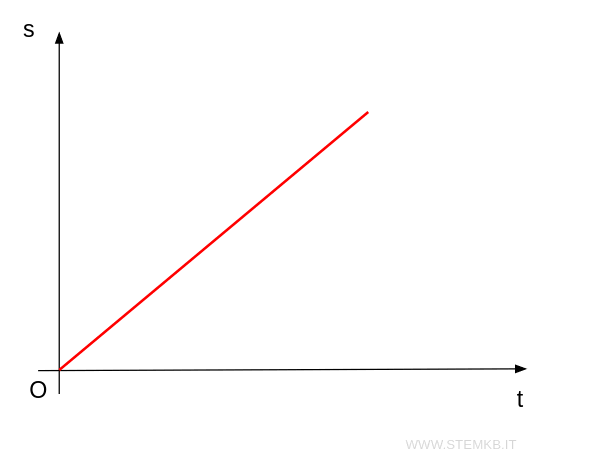
The straight line intersects the position axis at point \( s_0 \) when time \( t \) is 0, marking the initial moment of motion.
In other words, if you start from an initial position \( s_0 \), the final position \( s \) after a certain time \( t \) will be \( s_0 + vt \).
If the initial position is \( s_0 = 0 \) (i.e., you start from the origin), the formula simplifies to: $$ s = vt $$
A Practical Example
Let's go through a practical example to illustrate the concept of uniform rectilinear motion.
Imagine a car moving along a straight road at a constant speed of 60 km/h.
The car moves at a constant speed \( v = 60 \) km/h for a time \( t = 2 \) hours.
Assume we start measuring the car's position from a specific starting point, denoted as \( s_0 = 0 \) km.
We use the formula for uniform rectilinear motion:
$$ s = s_0 + vt $$
The given values are:
- \( s_0 = 0 \) km (initial position)
- \( v = 60 \) km/h (constant speed)
- \( t = 2 \) hours (elapsed time)
Now, let's substitute these values into the formula:
$$ s = 0 + 60 \times 2 $$
$$ s = 0 + 120 $$
$$ s = 120 $$
After 2 hours, the car will be 120 km from the starting point.
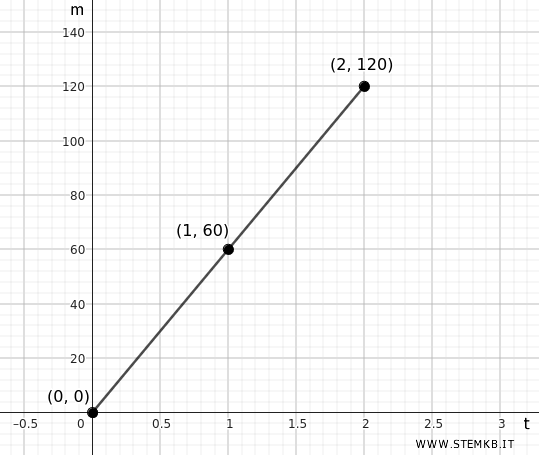
Now let's represent this motion on a space-time graph:
The horizontal axis (x) represents time \( t \) in hours, while the vertical axis (y) represents position \( s \) in kilometers.
For each hour that passes, the car travels 60 km. Therefore, the graph will be a straight line starting from the origin (0,0) and rising steadily to the right, with a slope representing the constant speed of 60 km/h.
Here’s a table showing the car’s position at different times:
\[
\begin{array}{|c|c|}
\hline
\text{Time (hours)} & \text{Position (km)} \\
\hline
0 & 0 \\
1 & 60 \\
2 & 120 \\
\hline
\end{array}
\]
This table shows how the car’s position changes linearly with time, following the law of uniform rectilinear motion \( s = s_0 + vt \).
Thus, the point (1,60) on the graph represents the car’s position after 1 hour, while the point \( (2, 120) \) represents the car’s position after 2 hours.
I hope this example helps you better understand the concept of uniform rectilinear


